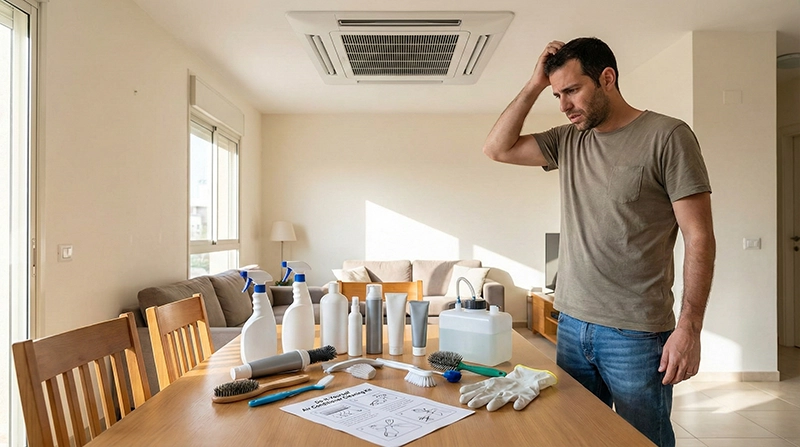

Air conditioner cleaning kit – a brilliant solution or a dangerous shortcut?
In recent years, we have been hearing more and more from customers who tell us:
“I bought Air conditioner cleaning kit On the internet, can it really replace a technician?”
The short answer: Not really.
The long answer: Air conditioner cleaning kit It can be a great tool for easy maintenance—but it doesn't replace a technician, and certainly not Deep cleaning of air conditioning ducts Or a mini central system.
Instead of rejecting it, let's try to figure out together what can be done with such a kit, what should not be attempted alone, and how to use it without damaging the system.
What exactly is included in an “air conditioner cleaning kit”?
In general, Air conditioner cleaning kit Typically includes one or more of the following items:
- Spray or foam cleaner for filters and accessible parts.
- Liquid or spray for gentle cleaning of batteries/evaporators.
- Soft brushes adapted for air vents.
- Short and safe instructions for use.
Sometimes there is also a video tutorial, sometimes not. What most kits have in common is that they are designed for:
- Refresh the filters.
- Surface cleaning of accessible parts.
- The feeling of “I did something for the air conditioner.”.
And that's great—as long as you remember that it's not a deep treatment of the system.
Where can an air conditioner cleaning kit help?
When used correctly, an air conditioner cleaning kit can be a nice part of your maintenance routine:
- It's easier to get started
Those who are a little apprehensive about opening filters feel more confident when they have clear instructions and tools. - Quick refresh mid-season
If the air conditioner runs for many hours a day, gently refreshing it with a kit can improve the feeling of cleanliness in the area—especially around the filters and external parts. - Translation of "Something I do for the house"
Often, simply spending a little time working on the system helps you identify problems earlier—odors, noises, leaks.
We are in favor of smart use of kits, as long as you understand Where does it end?.
What can't an air conditioner cleaning kit do?
Here, it is important to be as honest as possible. Even the most expensive gift will not make up for it:
- Cleaning air conditioning ducts
No home kit can fit a brush ball with an industrial vacuum cleaner into all the ducts in your home and clean them thoroughly. This requires professional equipment and experience. - Treating mold deep within the system
If there is mold inside ducts, inside a battery, or in areas that are inaccessible, spraying from the kit will not solve the problem, and sometimes it will only “smell good” for a few days. - Technical inspection of the system
Gas pressure, unusual noises, leaks—these are things that require a technician or professional, not a spray bottle. - Cleaning a large central/main mini system
This is a system that serves the entire house. An air conditioner cleaning kit may be able to refresh a small part of it, but it cannot replace thorough maintenance of the entire system.
How do you use the air conditioner cleaning kit without damaging the system?
If you decide to use the kit, there are a few red lines you should not cross:
- Work only on accessible parts
Filters, external plastic parts, areas that the manufacturer allows to be cleaned. Do not open internal parts that are not intended for home access. - Do not use too much cleaning agent.
More spray does not mean more cleaning. Excess material can remain inside the unit and interfere with airflow. - Do not spray deep into ducts or into the electrical system.
It sounds obvious, but in practice we see a lot of “creative inventions.”. - Follow the manufacturer's instructions for the air conditioner.
Not every material is suitable for every type of system. If in doubt, it is better to use less cleaning agent and more water and patience.
This way, an air conditioner cleaning kit remains a useful tool for easy maintenance and does not become a source of damage.
Air conditioner cleaning kit vs. professional cleaning – not either/or, but both
We don't expect customers to order professional cleaning for every speck of dust. On the contrary, self-maintenance is an important part of the picture. But instead of asking whether an air conditioner cleaning kit “replaces a technician,” it's worth thinking of it as an addition:
- kit – For routine, refreshing, and easy maintenance.
- Professional cleaning – When there is a persistent odor, dust that keeps coming back, a central system, ducts, or years without maintenance.
Especially in homes with air conditioning ducts, thorough professional cleaning of the system (including ducts) is what gives you that significant “boost” in air quality. On our service page, Cleaning air conditioning ducts, We explain what such treatment looks like and what it actually involves.
In summary: Air conditioner cleaning kit – a useful tool when used wisely
An air conditioner cleaning kit can be an excellent idea for those who want to feel like they are doing something for their air conditioner, keeping the filters clean and reducing dust and odors. It is not designed to replace professional deep cleaning, clean ducts, or “repair” a system that has accumulated years of dirt.
If you feel that the problem is deeper—a stuffy smell, recurring dust, a feeling of heavy air throughout the apartment—this is usually a sign to take it a step further and check what is happening inside the system itself, not just on the filter.
We are here to help you understand What you really need in your home – Not according to what is written on the kit box, but according to what actually happens in the air conditioning system.